
The Moderating Influence of Social Networking on the Relationship Between Single Household Status and Depression in Elderly Individuals
 ; Joohyun Lee**
Abstract
This study examined the moderating influence of social networks, including interactions with relatives, neighbors, and friends, on depression among elderly individuals living alone.
A cross-sectional secondary data analysis was conducted using the 2023 Community Health Survey in South Korea. The study included participants aged 60 years and above. Depressive symptoms were measured using the Patient Health Questionnaire-9 (PHQ-9), and the frequency of interactions within social networks was measured on a 6-point Likert scale. Multiple regression and simple slope graphs were employed to evaluate the moderating effects of social networks.
Elderly individuals living alone exhibited significantly higher depression levels compared to those living with others. Frequent interactions with relatives, neighbors, and friends were associated with lower depression levels. Furthermore, social networks were found to moderate the relationship between living alone and depression, with alleviation of depressive symptoms seen as social interactions increased. The interaction between living alone and social networks explained 28.2 to 28.5% of the variance in depression levels.
Social networks play a critical protective role in reducing depression among elderly individuals living alone. Strengthening social networks and promoting social engagement through community programs are vital strategies to address the mental health challenges of this population.
Keywords:
Aged, Depression, Social networking, Living alone, KCHSI . Introduction
Recently, health issues among elderly individuals have been the focus of attention in Korean society due to the rapid growth in the number of aging population (Lee, 2017). In 2024, the percentage of the older population among the total population was 19.2%, and it is expected to exceed 30% in 2036 (Statistics Korea, 2024). This increase in the elderly population has also led to an increase in elderly households consisting of individuals living alone. According to the Korean Elderly Statistics, as of 2023, 37.8% of all elderly households consisted of individuals living alone (Statistics Korea, 2024).
Depression among the elderly is a critical condition that worsens health and causes pain, family disruptions, disabilities, and increased mortality. It has been suggested that psychosocial adversities such as economic poverty, disability, social isolation, and lack of care have the potential to influence on the development of depression in the elderly, or to exacerbate existing depression (Alexopoulos, 2005) and to increase suicidal ideation (Shoib et al., 2021). According to the 2023 survey on the status of older persons in South Korea, for instance, 11.3% of the elderly aged 65 or older had depressive symptoms, and 1% had considered suicide in the past year. Therefore, there is a need to understand depression in older individuals and develop effective strategies to reduce it.
In general, elderly individuals living alone have a higher rate of depression than those who do not live alone. A previous study that investigated depression among elderly individuals residing independently in Korea discovered that around 46.3% of the participants exhibited symptoms of depression (Won & Choi, 2013). In addition, a study that investigated the prevalence of depression in middle-aged and older men showed that the rate was about twice as high in those living alone as in those who did not live alone (Choi & Lee, 2022). This suggests that older individuals living alone may have a higher prevalence of depression, highlighting the need for closer monitoring and support.
According to previous research (Won & Choi, 2013), elderly individuals who experience a paucity of coping mechanisms or social support resources exhibit elevated levels of depression in comparison to those who possess adequate resources. Furthermore, it has been demonstrated that the characteristics and size of the older person’s social network can exert a significant influence on the degree of loneliness and depression they experience (Domènech-Abella et al., 2017). A review paper on the protective effect of social support on depression revealed that the source of support that offers protection against depression varies according to the stage of life (Gariépy et al., 2016). The primary protective social relationship against depression for elderly individuals is their spouse, while family and friends also play important roles (Gariépy et al., 2016). In other words, the degree of depression in the elderly can vary depending on the social relationships and support that the elderly have. Elderly individuals who live alone, away from their spouse or family, for example, may be more vulnerable to depression. Therefore, it is very important to examine the social network of the elderly.
It has been demonstrated that social disconnection and isolation have a detrimental effect on both the physical and psychological health of people (Cornwell & Waite, 2009), it is necessary to simultaneously examine the psychological health status—such as depression—and the social networks of elderly individuals living alone. In fact, a previous study targeting elderly individuals residing alone in Korea reported that the elderly living alone have a weaker social network and are relatively socially isolated compared to the elderly living with others. Elderly individuals living alone, who often have weaker social networks, are more likely to be exposed to depression (Park et al., 2021). Consequently, an examination of the relationship between the variables is required.
Therefore, this study began with the research question: “Do social networks have a moderating effect on the association between single household status and depression in the elderly?” The objective is to assess the moderating influence of social network on the association among single household status and depression in the older population. The specific goals for study are as follows.
First, we analyze the proportion of elderly individuals living alone, the levels of social networking consisting of relatives, neighbors, and friends, and depression levels.
Second, we identify the correlation between social networks consisting of relatives, neighbors, and friends of the elderly and depression in elderly individuals.
Third, we analyze the moderating effect of social networking consisting of relatives, neighbors, and friends among the elderly population on the relationship between single household status and depression status.
Ⅱ. Methods
1. Research methodology
This descriptive study is a cross-sectional designed to examine the moderating effect of the social networking of relatives, neighbors, and friends on depression in older people residing alone. The study adopted a secondary analysis of the 2023 Survey on Community Health data. This is a national health survey carried out in Korea (Korea Centers for Disease Control and Prevention [KCDC], 2024).
2. Participants and sample size
The target subjects of this study are the elderly who responded in the 2023 Survey on Community Health. The survey was carried out in Korea targeting adults aged 19 years or over. The entire population was derived from data linked to the Ministry of the Interior and Safety and the Ministry of Land, Infrastructure and Transport. The sampling points were extracted using the probability proportional systematic sampling method on the basis of the number of households by housing type among Tong, Ban, and Ri, and the study subjects were derived using the systematic sampling methodology on the basis of the number of households (KCDC, 2024. This study was conducted on 109,304 people aged 60 years or older among 231,752 participants in the 2023 Community Health Survey who responded to all questions about depression and social networks.
3. Data collection and Research Ethics
The Community Health Survey in South Korea is an annual nationwide health-related survey. The survey is conducted on individuals aged 19 and above from sample households. The survey employs a face-to-face interview method, in which trained interviewers visit households to conduct interviews (KCDC, 2024). To gain access to the database, researchers were required to submit a research plan for review, and the data were provided in a form that does not include personally identifiable information. To ensure the highest standard of confidentiality, all data were kept strictly accessible only to the researchers. The authors obtained a waiver from the IRB of their institution (EUIRB2024-119).
4. Measurements
The degree of feelings of depression was scored using the Korean version of the Patient Health Questionnaire-9 (PHQ-9) (KCDC, 2024; Park et al., 2010). The PHQ-9 consists of nine self-reported questions and is commonly utilized as a preliminary instrument for major depressive disorder (Park et al., 2010). Each of the items was estimated on a 4-point Likert scale based on the experience of depressive symptoms in the past two weeks from the survey date, and the total score was estimated on a scale, ranging 0 to 27, with a greater value reflecting a greater degree of depression. The Cronbach’s alpha for the Korean version of the PHQ-9 was .84 (Park et al, 2010), and in this study, it was .80.
Social networks were measured by asking participants how frequently they meet or contact their relatives, neighbors, and friends. The question consisted of three items. Relatives were defined to include members of the family who did not live with the participant, while friends were defined to exclude neighbors. Each question was rated on a scale of 1 to 6, with the choices being: less than once a month, once a month, 2-3 times a month, once a week, 2-3 times a week, and more than 4 times a week. Higher scores indicated more frequent contact or meetings.
The presence of older adults living alone was determined by asking whether they resided with anyone. Participants were divided into two groups: those residing alone and those residing with two or more people.
To elucidate the relationship between living alone, depression, and social networks, this study controlled for variables such as gender, age, household income, perceived health status, and perceived stress level based on previous studies. Household income was measured by asking about average monthly or annual income from all sources and converting this to monthly income. The perceived health status of participants was measured on a scale of 1 to 5, with participants rating their own health. A higher score on perceived health status is indicative of better health status. Perceived stress levels were measured on a scale of 1 to 4, based on the level of stress felt by the participant in the past two weeks. A higher score on perceived stress levels is indicative of a higher stress status.
5. Statistical Analyses
As 2023 Community Health Survey is a survey that is based on a sample, it is recommended that stratification variables, clustering variables and weights are considered in the analysis to reflect the complex sample design (KCDC, 2024). This study was undertaken in adherence to the 2023 guidelines. Descriptive statistics such as unweighted frequencies, weighted percentages, means values, and standard errors, have been used to analyze the general characteristics of participants, living alone status, depression, and social networks (relatives, neighbors, and friends). Pearson’s correlations were calculated to compare the relationships between depression in older adults and social networks. Multiple regression analysis was used to develop predictive models for living alone status, depression, and social networks in older adults. Simplified slope analysis was employed to test the moderating effect of social networks by dividing participants into two groups based on their level of social networks (Hayes, 2013).
Ⅲ. Results
1. Characteristics of participants
The characteristics of the subjects are presented in Table 1. Among subjects, 54.3% were female, and the average age was 70.44 years. The percentage of elderly residing alone was 19.7%, on a monthly income of 3.08 million Korea won. Social networking and depression scores appear in Table 2. The mean social network score with relatives was 3.89, with neighbors was 3.48, and with friends was 3.42. The participants' perceived health status was 3.52, and their perceived stress level was 2.17.

Characteristics of Participants(N=109,304)
Levels of Social networks and Depression
2. Correlation between depression and social networks in elderly individuals
The correlation coefficients between main variables are presented in Table 3. The result indicate a reverse correlation between depression in elderly and the social networking with extended family members (r=-.06, p<.001), with neighbors (r=-.08, p<.001), and with friends (r=-.14, p<.001).
Correlations between Depression and Social Networks
3. The moderating influence of social networking on the association among single household status and depression in elderly individuals
The moderating influence of social networks on depression in older individuals residing by themselves is illustrated in Table 4. The analysis revealed that older individuals residing by themselves exhibited higher depression scores compared to those living with two or more people (social networks with relatives, B=0.88, t=10.81, p<.001; neighbors, B=0.89, t=12.84, p<.001; friends, B=0.85, t=11.94, p<.001), and the more frequently they were connected to relatives, neighbors, and friends, the lower their depression scores (social networks with relatives, B=-0.08, t=-10.39, p<.001; neighbors, B=-0.10, t=-16.21, p<.001; friends, B=-0.10, t=-13.73, p<.001). In addition, the interaction between living alone and social networks with relatives, neighbors, and friends showed a significant correlation with the depression scores (social networks with relatives, B=-0.07, t=-3.97, p<.001; neighbors, B=-0.08, t=-5.30, p<.001; friends, B=-0.06, t=-3.799, p<.001). The model, incorporating both living alone and social networks, along with the interactions between these variables, explains 28.2% of the variance in social networks with relatives, 28.5% of the variance in social networks with neighbors, and 28.3% of the variance in social networks with friends.
The Moderating Effect of Social Networks on Depression in Elderly Individuals Living Alone
The simplified slope analysis in Figure 1 demonstrates that older adults residing alone exhibit higher level of depression in relation to those living with others. However, depression levels have been observed to decline as older adults cultivate more dynamic social networking with relatives, neighbors, and friends. In essence, older individuals with more active social networks with relatives, neighbors, and friends demonstrate reduced levels of depression compared to those with less active social networks.
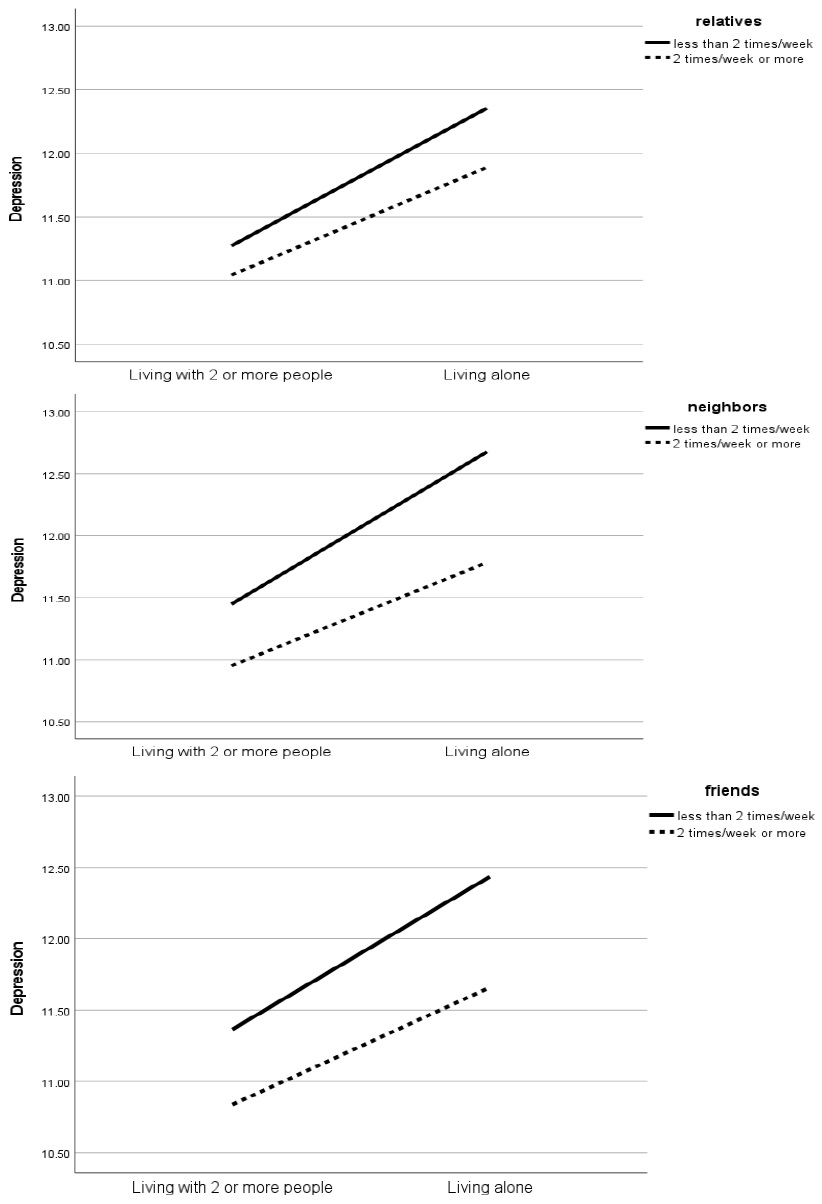
Interaction between Living Alone and Social Network on Depression in Elderly : Social Network as a Moderator
Ⅳ. Discussion
The study was done to assess the moderating influence of social networks on the association between household status (living alone vs living with others) and the feelings of depression in community-living older individuals. The results revealed that elderly residing alone demonstrated significantly higher levels of depressive symptoms in relation to those living with others, a finding that aligns with previous studies (Choi & Lee, 2022; Won & Choi, 2013). Research that has previously investigated the relationship among solitude and depression in older people and the social networks showed similar results (Domènech-Abella et al., 2017). The findings indicated that a lower amount of social connections or a reduced social network were associated with higher levels of solitude and depression. Elderly residing by themselves were likely to experience fewer social interactions within their households than those living with others, making them more vulnerable to loneliness and depression. In order to address this issue, it is crucial to establish broader social networks outside the home and enhance opportunities for social interactions.
The correlation between social networks and depression is not only pertinent to the day-to-day lives of the elderly (Santini et al, 2020), but also to those who have experienced significant life events (Hamid et al., 2019). Previous studies showed that depression in older people who had experienced major life events was significantly associated with their social networks (Hamid et al., 2019). Compared to the past, the increasing prevalence of divorce (Statistics Korea, 2024) and the loss of a spouse due to aging or illness highlighted the critical role of social connections in alleviating depression in older people.
Recent Korean Elderly Statistics (2024) indicated that 18.7% of elderly individuals living alone had no one they could rely on for help, and 26.6% did not interact with family or relatives. These proportions were consistent with previous statistics (Statistics Korea, 2022; Statistics Korea, 2020), suggesting that the percentage of socially isolated elderly individuals had remained persistently high as the elderly population increased. It is therefore vital that social efforts are made to relieve feelings of solitude and depression in older individuals residing alone.
The findings of this study indicate that the amount of interaction with relatives, neighbors, and friends has a great effect on the prevalence of depression in elderly individuals residing alone, in contrast to those residing with others. In other words, the elderly who live alone have higher levels of depression than the elderly who do not, but their depression level can be improved through relationships with relatives, neighbors, and friends. This finding indicates that the presence of a supportive individual can function as a substantial protective factor for the mental well-being of elderly individuals. A similar finding was reported in a study conducted among elderly individuals in Asian cultural contexts, where frequent interactions within several social networking were found to have a beneficial effect against depressive symptoms, as they were negatively correlated with depressive symptoms (Aung et al., 2016). A subsequent review on the relationship between the structure of social networking and depression in the elderly concluded that not only the frequency of the social networks, but also the extent of social networks and the variety of contacts, as well as having many friends, served as protective factors against depression (Aung et al., 2016). Consequently, health providers working with elderly individuals should assess the social networks available to them to explore risks of social isolation, and strengthen networking opportunities for elderly individuals as a strategy to prevent depression. Specifically, the development of diverse community-based programs targeting the elderly and the encouragement of their participation has the potential to strengthen their social networks and prevent depression.
However, there are a several constraints to this study. Firstly, the original data collection was not conducted with the specific purpose of this study, which limited the precise investigation of social networks among the elderly. Future research should conduct more detailed assessments of elderly individuals’ social networks and compare these with psychological health outcomes. Secondly, it should be acknowledged that the cross-sectional survey method of the data in present study limits the ability to establish causal relationships between social networks and depression in the elderly. Consequently, caution must be exercised when interpreting associated factors.
Ⅴ. Conclusion
The study explores the moderating effect of social networking, encompassing interactions with relatives, neighbors, and friends, on depression in older individuals residing by themselves. The findings indicates that those who are alone experience significantly higher degree of depression in relation to those living with others. However, frequent interactions with relatives, neighbors, and friends were found to attenuate depression, underscoring the protective function of social networks for mental health.
The identification of strategies to strengthen social networks and encourge active participation in community activities is recommended, with the aim of alleviating feelings of solitude and preventing depression in elderly individuals. From the perspective of public health nurses, they can develop various physical or emotional programs using community resources to provide opportunities for elderly individuals living alone in the community to expand their social network. This can be achieved by implementing strategies to reduce depression in elderly individuals living alone. The promotion of mental well-being and the creation of a more inclusive society can be achieved by identifying and supporting those who are susceptible to social isolation. Further research is recommended to explore these relationships in greater depth, with the aim of informing effective interventions for improving mental health for the aging population.
References
-
Alexopoulos, G. S. (2005). Depression in the elderly. Lancet, 365(9475), 1961–1970.
[https://doi.org/10.1016/S0140-6736(05)66665-2]

-
Aung, M. N., Moolphate, S., Aung, T. N., Katonyoo, C., Khamchai, S., & Wannakrairot, P. (2016). The social network index and its relation to later-life depression among the elderly aged ≥80 years in Northern Thailand. Clinical Interventions in Aging, 11, 1067–1074.
[https://doi.org/10.2147/CIA.S108974]
-
Choi, H. S., & Lee, J. E. (2022). Factors affecting depression in middle-aged and elderly men living alone: a cross-sectional path analysis model. American Journal of Men's Health, 16(1), 15579883221078134.
[https://doi.org/10.1177/15579883221078134]
-
Cornwell, E. Y., & Waite, L. J. (2009). Social disconnectedness, perceived isolation, and health among older adults. Journal of health and social behavior, 50(1), 31–48.
[https://doi.org/10.1177/002214650905000103]
-
Domènech-Abella, J., Lara, E., Rubio-Valera, M., Olaya, B., Moneta, M. V., Rico-Uribe, L. A., Ayuso-Mateos, J. L., Mundó, J., & Haro, J. M. (2017). Loneliness and depression in the elderly: the role of social network. Social Psychiatry and Psychiatric Epidemiology, 52(4), 381–390.
[https://doi.org/10.1007/s00127-017-1339-3]
-
Gariépy, G., Honkaniemi, H., & Quesnel-Vallée, A. (2016). Social support and protection from depression: systematic review of current findings in Western countries. The British Journal of Psychiatry: The Journal of Mental Science, 209(4), 284–293.
[https://doi.org/10.1192/bjp.bp.115.169094]
- Hamid, T. A., Dzaher, A., & Ching, S. M. (2019). The role of social network, social support, religiosity and depression among elderly Malaysians who had experienced major life events. The Medical journal of Malaysia, 74(3), 198–204.
- Hayes, A. F. (2013). Introduction to mediation, moderation, and conditional process analysis: a regression-based approach. The Guilford Press.
- Korea Centers for Disease Control and Prevention (KCDC). (2024 February 26). 2023 Korean Community Health Survey (KCHS) raw data usage guideline. https://chs.kdca.go.kr/chs/mnl/mnlBoardMain.do
- Lee, J. W. (2017). Problems and improvement of the medical service for elderly people towards super-aged society. The Journal of Law, 25(4), 181-203.
- Park, S. J., Choi, H. R., Choi, J. H., Kim, K., & Hong, J. P. (2010). Reliability and validity of the Korean version of the patient health questionnaire-9 (PHQ-9). Anxiety and Mood, 6(2), 119-124.
-
Park, S., Kim, T. H., & Eom, T. R. (2021). Impact of social network size and contact frequency on resilience in community-dwelling healthy older adults living alone in the Republic of Korea. International journal of environmental research and public health, 18(11), 6061.
[https://doi.org/10.3390/ijerph18116061]
-
Santini, Z. I., Jose, P. E., York Cornwell, E., Koyanagi, A., Nielsen, L., Hinrichsen, C., Meilstrup, C., Madsen, K. R., & Koushede, V. (2020). Social disconnectedness, perceived isolation, and symptoms of depression and anxiety among older Americans (NSHAP): a longitudinal mediation analysis. The Lancet. Public health, 5(1), e62–e70.
[https://doi.org/10.1016/S2468-2667(19)30230-0]
-
Shoib, S., Islam, S. M. S., Arafat, S. Y., & Hakak, S. A. (2021). Depression and suicidal ideation among the geriatric population of Kashmir, India. The International journal of social psychiatry, 67(6), 651–655.
[https://doi.org/10.1177/0020764020968592]
- Statistics Korea. (2024 September 26). 2024 Senior citizen statistics. https://kostat.go.kr/board.es?mid=a10301060500&bid=10820&act=view&list_no=432917
- Statistics Korea. (2022 September 29). 2022 Senior citizen statistics. https://kostat.go.kr/board.es?mid=a10301010000&bid=10820&tag=&act=view&list_no=420896&ref_bid
- Statistics Korea. (2020 September 28). 2020 Senior citizen statistics. https://kostat.go.kr/board.es?mid=a10301060500&bid=10820&act=view&list_no=385322&tag=&nPage=1&ref_bid=
-
Won, M. R., & Choi, Y. J. (2013). Are Koreans prepared for the rapid increase of the single-household elderly? Life satisfaction and depression of the single-household elderly in Korea. The Scientific World Journal, 2013, 972194.
[https://doi.org/10.1155/2013/972194]