Psychometric Evaluation of the Korean Adaptation of the Disaster Preparedness Awareness Scale
 ; Jung, Cha-Gyun***
; Yoon, Gyuyoung****
; Kan Shimazaki*****
; Shihoko Kajiwara******
; Naomi Akiyama*******
; Jung, Cha-Gyun***
; Yoon, Gyuyoung****
; Kan Shimazaki*****
; Shihoko Kajiwara******
; Naomi Akiyama*******
Abstract
In this research, the Japanese Disaster-Prevention Consciousness Scale (J-DPCS) was culturally adapted and translated for use in Korea, and its psychometric performance was thoroughly assessed to verify the reliability and validity of the resulting Korean Disaster-Prevention Consciousness Scale (K-DPCS). The K-DPCS assesses psychological readiness for disasters across the cognitive and emotional domains.
A methodologically standardized translation and cultural adaptation procedure was undertaken, followed by a nationwide web-based survey of 450 adults. Subsequently, exploratory and confirmatory factor analyses yielded a refined 11-item measure with a theoretically coherent four-factor structure, encompassing Imagination of Damages, Sense of Crisis, Other-directedness, and Anxiety.
Internal reliability for the refined instrument fell within acceptable to good levels (α = 0.508–0.773), and the model demonstrated strong fit according to global indices (CFI = 0.976, RMSEA = 0.039). Furthermore, item response theory analyses substantiated the psychometric soundness and discriminatory capability of the individual items. A cross-cultural comparison with a Japanese cohort revealed significantly elevated levels of preparedness consciousness among Korean participants, particularly in the domain of social orientation.
The K-DPCS represents a psychometrically rigorous and culturally attuned assessment tool for measuring disaster preparedness consciousness in South Korea and has implications for enhancing public education and international communication regarding disaster risk.
Keywords:
Disaster Planning, Psychometrics, Cross-Cultural Comparison, Risk Assessment키워드:
재난대비계획, 심리측정, 문화 간 비교, 위험평가I. Introduction
Natural disasters have increased in both intensity and frequency worldwide, posing profound risks to infrastructure, socioeconomic stability, and—critically—human safety and collective community resilience (Centre for Research on the Epidemiology of Disasters [CRED], 2020). According to a 2020 Centre for Research on the Epidemiology of Disasters (CRED) report, more than 1.2 million lives were lost globally to natural disasters between 2000 and 2019, underscoring the urgent need for integrated, adaptive disaster-preparedness strategies. Although structural and institutional readiness remain fundamental, psychological readiness—conceptualized as the individuals' awareness, attitudes, and cognitive appraisal of disaster risk—has increasingly been recognized as a pivotal determinant of prompt response behaviors and effective post-disaster recovery (Paton, 2003). Recent studies in disaster psychology emphasize that psychological readiness enhances adaptive coping and mitigates trauma-related outcomes following disaster exposure (Reifels & Dückers, 2023). Consequently, integrating psychological components into disaster management frameworks has become a global priority.
In the past two decades, natural hazards in South Korea, including typhoons, flooding, landslides, and heatwaves, have intensified and become more frequent, events strongly associated with rapid climate change (Intergovernmental Panel on Climate Change, 2021; Kim & Kim, 2022). According to the Ministry of Interior and Safety, South Korea (Ministry of the Interior and Safety [MOIS], 2021), economic losses from natural disasters more than tripled between 2000 and 2020, underscoring the need for strengthened disaster risk reduction strategies. Despite this growing exposure, there is a lack of culturally adapted instruments to assess the psychological readiness for disasters among the Korean population (Kim et al, 2022). Previous Korean studies have mainly focused on behavioral preparedness, institutional systems, or the competencies of healthcare professionals (Han & Chun, 2021; Kim, 2023, Noh et al, 2017), with relatively few examining the cognitive or affective factors that shape individuals' disaster-related perceptions. This gap limits the development of targeted educational and policy interventions. Therefore, identifying and measuring the psychological dimensions of disaster preparedness is essential for promoting comprehensive and sustainable disaster readiness among the Korean population.
To complement existing evaluations of disaster prevention that mainly focus on physical preparedness or specific disaster scenarios, it is essential to assess psychosocial preparedness—that is, the awareness, motivation, and psychological readiness among individuals to act appropriately during disasters. The Japanese Disaster-Prevention Consciousness Scale (J-DPCS) was originally formulated by Shimazaki and Ozeki (2022) to delineate the conceptual structure of disaster-prevention consciousness among individuals without formal training in disaster management. The exploratory factor analyses provided evidence supporting both the instrument's reliability and its underlying construct structure, confirming its appropriateness for evaluating general disaster-preparedness consciousness independent of specific disaster scenarios. The J-DPCS is accessible through the National Research Institute for Earth Science and Disaster Resilience (NIED), Japan's leading governmental agency for disaster research (NIED, 2025). Since its development, the scale has been widely used in surveys targeting Japanese residents and has demonstrated stable reliability and validity. Moreover, it has been applied to foreign populations, including foreign residents in Japan (Kawanabe et al, 2022) and international tourists (Choi et al, 2023). However, no study to date has examined the translation process or investigated the factor structure of its underlying construct in other languages. Accordingly, this study sought to develop and validate a Korean version of DPCS (K-DPCS), offering a tool to assess psychosocial preparedness while incorporating cultural considerations as a relevant—though secondary—component of the translation and conceptual adaptation process.
Furthermore, disaster consciousness is deeply influenced by the sociocultural context. Comparative studies have shown that perceptions of disaster risk, anxiety, and collective responsibility vary significantly across countries and cultural orientations (Hofstede, 2001; Hofstede et al, 2010; Iizuka, 2022; Krongthaeo et al, 2022; Martinez-Rives et al, 2025). South Korea's collectivist culture—characterized by group harmony, social obligation, and interdependence—contrasts with Japan's relatively more balanced orientation between collectivism and individualism (Hofstede et al, 2010). This cultural framework may lead South Koreans to view disaster preparedness as a shared social duty rather than an individual responsibility, influencing both the emotional and cognitive dimensions of readiness. Without culturally sensitive tools, these underlying psychological and cultural nuances cannot be accurately captured.
In line with this aim, the study focused on two key tasks: Developing and psychometrically validating a culturally adapted Korean version of the DPCS and examining the differences in the psychological preparedness between Korean and Japanese adults.
Beyond its domestic implications, the development of the K-DPCS has international relevance. South Koreans are among the largest groups of international travelers to Japan, with over 720,000 arrivals recorded in April 2025 alone (Japan National Tourism Organization, 2025). In an increasingly mobile global society where disaster risks transcend national borders, enhancing disaster awareness through culturally appropriate assessment tools is vital to international safety, cooperation, and public health (Reifels & Dückers, 2023). Taken together, this study provides a foundation for evidence-based, culturally responsive approaches to disaster preparedness that can strengthen both national resilience and global collaboration.
Ⅱ. Methods
1. Translation and Cultural Adaptation
A standardized cross-cultural translation procedure was employed to develop the K-DPCS. Two independent bilingual translators prepared the initial Korean translations of the original Japanese 20-item J-DPCS. The two preliminary translations were reviewed and consolidated, after which a separate bilingual translator—who had no access to the original scale—back-translated the reconciled version into Japanese. After the back-translation was completed, the item set was examined by four experts, including the original Japanese scale developer, two scholars in disaster preparedness, and a Korean language education expert, to verify both semantic and conceptual consistency. Following the expert consultation, the instrument was pilot tested for linguistic precision and cultural fit, and minor textual refinements were applied to finalize the Korean adaptation.
2. Participants and Data Collection
Recruitment was conducted through a collaboration between Global QiQUMO, an international online research agency, and a domestic Korean survey platform. Eligible respondents were Korean adults residing in South Korea. To ensure data quality, the platform applied internal validation protocols to prevent duplicate registrations and responses, including the exclusion of repeat participants identified through respondent ID tracking. A stratified sampling approach was used to reflect the gender and age distribution of the Korean population, drawing on published demographic data. The target sample size was determined based on scale validation guidelines, which suggest 10–20 respondents per item (Boateng et al, 2018). With 20 items in the K-DPCS, a minimum of 400 participants were required; thus, 450 participants were recruited to account for possible attrition or invalid responses.
3. Study Design
To examine disaster-preparedness consciousness among Korean adults, the study used a web-based survey within a cross-sectional research framework. An online, self-completed questionnaire was administered to participants via a commercial survey platform. Respondents provided responses to the K-DPCS along with demographic information such as age, gender, disaster-related experiences, and prior residence in Japan.
4. Instruments
The original Japanese Disaster-Prevention Consciousness Scale, a 40-item measure, was first developed by Shimazaki and Ozeki in 2022. A shortened 20-item version was subsequently established by selecting four representative items from each of the five subfactors, improving usability while maintaining conceptual coverage. Comprising 20 items, the J-DPCS evaluates five aspects of disaster-preparedness consciousness: Damage imagination (F1), perceived crisis related to existing disaster-response measures (F2), other-directedness (F3), disengagement or indifference toward disaster prevention (F4), and anxiety (F5). The scale demonstrated acceptable reliability among 618 Japanese adult participants, with Cronbach’s α ranging from 0.55 to 0.85 and McDonald’s ω ranging from 0.52 to 0.85. Construct validity was confirmed through exploratory factor analysis (EFA), with a cumulative contribution ratio of 50.9%, exceeding that of the original 40-item version. Criterion-related validity was supported through significant correlations (ρ = –0.24 to 0.45) with four established Japanese disaster-awareness scales. Although widely used, the J-DPCS had not been formally translated or validated into other languages prior to the present study (Cernuda Martínez & Arcos González, 2025).
A preliminary Korean version of the DPCS was created through a systematic cross-cultural adaptation process, including forward translation by bilingual experts, back-translation, reconciliation, and cognitive interviews with Korean adults. The adaptation retained all 20 items and applied the original J-DPCS 4-point Likert scale (1 = strongly disagree; 4 = strongly agree) to the Korean version. This version was administered to evaluate linguistic clarity, conceptual equivalence, and factor structure in the Korean context.
5. Statistical Analysis
Using the same dataset for both exploratory factor analysis (EFA) and confirmatory factor analysis (CFA) due to the modest sample size provided preliminary support for the structural validity of the Korean version. Boateng et al. (2018) advise validating EFA-derived factor structures using CFA on an independent sample or a randomly split dataset. In this study, however, such an approach was not feasible due to sample size limitations. Therefore, similar to many validation studies conducted under practical limitations (Izquierdo et al, 2014), we performed both analyses using the same data, with appropriate caution in interpretation. The CFA results were interpreted as preliminary evidence of cross-cultural structural validity rather than a definitive test of model generalizability. Principal axis factoring was used to extract factors, and a promax rotation was then applied during the EFA procedure. Items with standardized factor loadings of 0.50 or higher were retained in the final model. Reliability for each latent factor was assessed using Cronbach's α and McDonald's ω. An item response theory (IRT) two-parameter logistic (2PL) model was applied to examine item-level characteristics, yielding estimates of item discrimination and difficulty.
Additionally, item–total correlations were obtained, and 95% confidence intervals were generated via bootstrap procedures comprising 2,500 resamples. Subsequently, CFA was used to assess whether the EFA-derived factor solution was consistent with the conceptual structure proposed in the Japanese version of the instrument. All analyses were performed using JMP Pro 18.0 and R 4.4.1, with the significance level set at p < .05.
Given the non-normal distribution of the data, cross-national differences in disaster-preparedness consciousness were examined using the Mann–Whitney U test to compare median K-DPCS total and subfactor scores between Korean and Japanese respondents. The Japanese sample consisted of 618 participants, with data sourced from earlier published analyses employing the original J-DPCS (Shimazaki & Ozeki, 2022). Graphical visualization was used to depict the comparison.
6. Ethical Considerations
In accordance with the ethical guidelines for studies involving human participants, the research protocol was submitted to and approved by the Kindai University Ethics Committee (R6-2-004). Prior to the start of data collection, the ethics committee reviewed and approved all study documentation, including the protocol, participant information, consent form, and online survey. Prior to consent, individuals were briefed on the study objectives, the participation requirements, their right to discontinue at any time, and the data security measures. All responses were anonymized, securely stored on password-protected servers, and utilized solely for research. No personal identifiers were obtained, and all procedures complied with institutional and national research ethics standards.
Ⅲ. Results
1. Translation and Presentation of K-DPCS
Two independent researchers, proficient in Japanese and Korean, conducted the translations to ensure linguistic and conceptual accuracy. For item Q15, the original Japanese version included specific terms such as “seismic reinforcement” and “seawall construction.” However, during the Korean translation process, the wording was revised to account for the possibility that some respondents—depending on their generation or region—might not be familiar with such terms. Discussions were held with the original scale developers during item revision, and it was confirmed that the intention was to assess respondents' belief that “physical measures alone were sufficient for disaster preparedness.” Based on this clarification, the item was modified as follows: “If we just take measures to prevent buildings and other structures from collapsing before a disaster occurs, we will be safe.”
A pilot test was conducted with 14 participants residing in South Korea to confirm that there were no issues with the comprehension or responses before administering the main survey.
2. Participant Characteristics
The sample consisted of 450 individuals (Table 1). A large proportion (79.6%) were aged 20–59 years, with approximately equal number of male and female participants (49.1% male vs. 50.7% female). The majority of participants (92.0%) had never lived in Japan. In terms of employment, the most common category was company employees (44.4%), followed by homemakers (19.6%). Regarding disaster experience, typhoons (56.2%), heavy rain (53.3%), and heavy snow (37.1%) were the most frequently reported events.

Characteristics of Participants(n=450)
3. Factor Structure and Cross-Cultural Comparison of the K-DPCS
At the outset, the entire set of 20 DPCS items was adapted, reflecting an attempt to preserve the five foundational dimensions—imagination of the damages, sense of crisis to current measures against disaster, other-directedness, indifference to disaster prevention, and anxiety. However, EFA with maximum likelihood estimation and Promax rotation revealed a markedly different structure. Several items exhibited low factor loading (< 0.40) or cross-loadings across multiple factors, and the cumulative contribution ratio remained approximately 30%, suggesting limited structural validity of the direct translation model. To improve conceptual clarity and psychometric adequacy, item selection was guided by both statistical and theoretical criteria. In addition to examining factor loadings, the research team, including experts in disaster psychology and two bilingual researchers, reviewed each item for conceptual relevance and cultural appropriateness. Items were excluded when their content overlapped semantically with others, lacked clarity in the Korean context, or deviated from the original conceptual domains of the J-DPCS. After this iterative process, a refined 11-item scale was developed. Table 2 shows that the EFA extracted four factors—imagination of the damages, concern for disasters, other-directedness, and anxiety—which together explained 60.86% of the total variance (TLI = 0.953; RMSEA = 0.046). Across these factors, Cronbach's α ranged from 0.51 to 0.77, while McDonald's ω ranged from 0.52 to 0.90. Taken together, these indices support acceptable internal reliability for a scale undergoing initial validation.
Exploratory Factor Analysis of the Refined Korean Version of the Disaster Preparedness Consciousness Scale (K-DPCS)
4. CFA-Based Assessment of the Structural Validity of the K-DPCS
As shown in Figure 1, the 11-item K-DPCS was evaluated using a CFA framework within a structural equation modeling framework. The model fit statistics were robust—TLI = 0.966, SRMR = 0.039, CFI = 0.976, and RMSEA = 0.039 (90% CI: 0.018–0.057). These values all exceeded the standard criteria for good fit, providing strong empirical support for the structural model. The factor loadings, ranging from 0.474 to 1.184, were generally above 0.60. These values indicate that most items were strongly associated with their intended latent constructs. The coefficient of determination (R²) for the individual items ranged from 0.224 to 0.603, indicating the model's explanatory power.
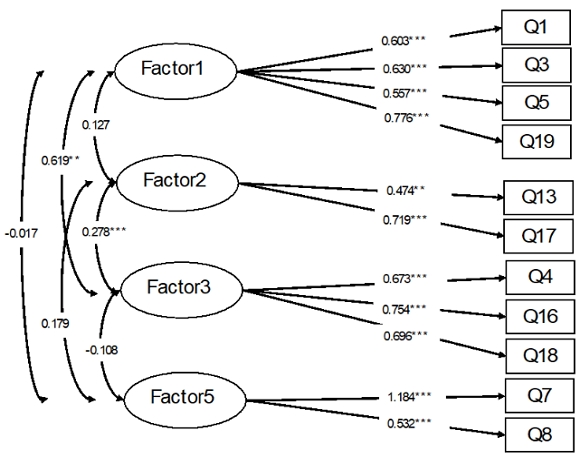
Modified Korean version of Disaster Preparedness Consciousness Scale (K-DPCS) based on structural equation modeling.Structural equation modeling (SEM) was used to examine relationships among latent constructs. All coefficients are reported as standardized estimates.Factor1: Imagination of the Damages, Factor2: Concern for Disasters, Factor3: Other-directedness, Factor5: Anxiety
Although Item Q7 exhibited a standardized factor loading greater than 1.0 (1.184) and a negative residual variance, indicating a Heywood case—a statistical anomaly in which a factor loading exceeds 1.0 or an error variance becomes negative—it was retained in the model. The choice was guided by both conceptual considerations and the robustness of the model fit statistics, which showed excellent values (CFI = 0.976; RMSEA = 0.039; SRMR = 0.039). Given a sufficiently large sample size (n = 450), the Heywood case is unlikely to have resulted from sampling error alone (Byrne, 2016). Rather than excluding Q7, we interpret this finding as a statistical artifact, possibly due to high inter-item correlations or model overfitting, and acknowledge the need for further validation in future studies.
The correlations among latent factors revealed two significant positive associations—between imagination of the damages and other-directedness (r=0.619, p<.01), and between sense of crisis and other-directedness (r=0.278, p<.001)—suggesting that individuals who can vividly imagine impact of disasters or feel a stronger sense of crisis also tend to display greater concern for others. In contrast, correlations involving anxiety were weak and nonsignificant (r= –0.017 to –0.108), indicating that this emotional component may represent a relatively independent dimension of disaster-prevention consciousness. Overall, the four latent factors—imagination of the damages, sense of crisis, other-directedness, and anxiety—were moderately interrelated yet conceptually distinct, confirming the multidimensional structure of the K-DPCS. Taken together with the strong global fit, these findings suggest that the K-DPCS assesses a multidimensional yet coherent construct: Factors are positively related where theoretically expected, while the emotional factor (anxiety) functions as a partially independent but conceptually relevant component. Negative inter-factor correlations observed during the EFA were explained by the presence of reverse-coded items, which were verified and adjusted during the CFA.
5. Item-Level Analysis of the Final K-DPCS Items
Item-level findings for the 11 items that remained after factor analysis are reported in Table 3. Their psychometric performance was examined using both item response theory metrics and item–total correlations. The difficulty parameters ranged from –2.013 (Q7) to 0.699 (Q5), indicating that the items covered a broad range of latent traits. Most items showed acceptable discrimination (>0.7), with Q17 demonstrating particularly high discrimination (3.396). The association between individual items and the total scale score ranged from 0.293 (Q13) to 0.783 (Q19), with all correlations significant at p < 0.001. These findings indicate that the final set of items demonstrated acceptable internal consistency and sound psychometric properties. Although a few items, such as Q13, showed relatively low item-total correlations (e.g., r = 0.293), they were retained based on their theoretical relevance and factor loadings. In particular, Q13 contributed meaningfully to the sense of crisis to current measures against disaster factor in factor analysis. The final version of K-DPCS, including all 11 items, is presented in Table 4.
Item Response Parameters and Item-total Correlations for the Revised Korean Version of Disaster Preparedness Consciousness Scale (K-DPCS)
The Korean Version of the Disaster Preparedness Consciousness Scale
6. Comparison of K-DPCS Scores Between South Korean and Japanese Participants
A box plot illustrating the differences in subscale scores between the revised K-DPCS and the original Japanese version (Japanese sample: n = 618) is shown in Figure 2. We surveyed 618 adult men and women (mean age: 46.2 years) across Japan, selected randomly from an online survey panel of approximately 2.3 million individuals registered with Macromill company.
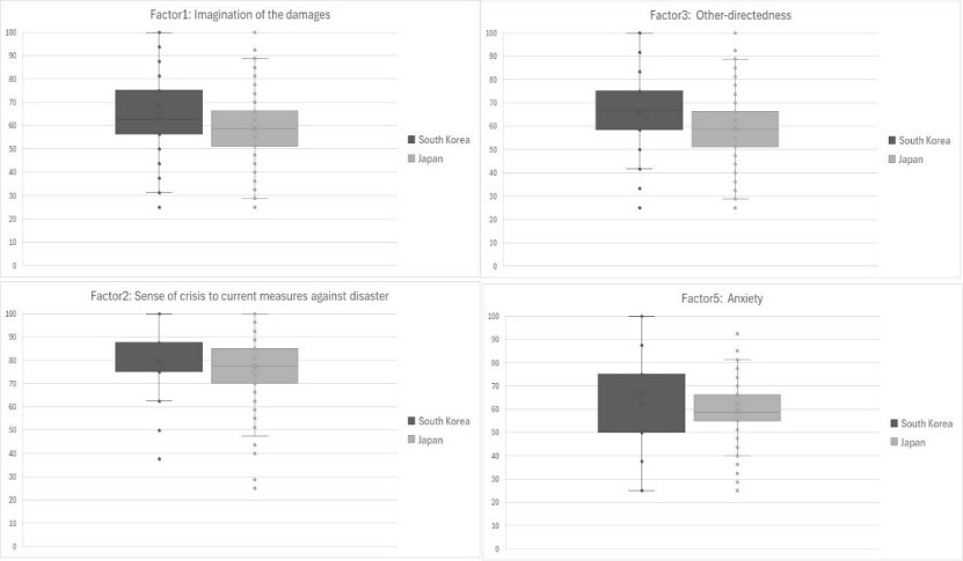
Comparison of Disaster Preparedness Consciousness Scale (DPCS) Score Rates Between Korean and Japanese ParticipantsThe box shows the interquartile range (IQR), with the median represented by the horizontal line. The vertical axis represents the DPCS score rate (%, percentage).
Since the number of items per factor differs between the two versions—some factors in the Japanese version include four items, while the Korean version has only two—raw scores were converted to percentages of the maximum possible score for each subscale. This standardization enabled direct visual comparison across cultures on a 0–100 scale, regardless of item count.
To evaluate differences in subscale scores between participants from South Korea and Japan, we used Wilcoxon rank-sum tests. Although the scale structures differ slightly between the two versions, the results were interpreted as preliminary cross-national comparisons. South Korean participants showed significantly higher median scores across all four comparable subscales (p < .01).
Ⅳ. Discussion
1. Implications for Structural Validity and Reliability of the K-DPCS
This study aimed to develop and validate the K-DPCS, an adaptation of the original Japanese version by Shimazaki and Ozeki (2022). Through a rigorous translation and adaptation process involving bilingual experts, the original scale was carefully reviewed to ensure conceptual equivalence and linguistic clarity. Psychometric testing showed that the revised 11-item K-DPCS aligned well with the theoretical model of the original Japanese instrument and exhibited satisfactory reliability and structural validity in the Korean setting.
The CFA results supported a well-fitting four-factor structure, with strong model fit indices (TLI = 0.958, SRMR = 0.039, CFI = 0.971, and RMSEA = 0.044). All standardized loadings across the cognitive (F1–F2), social (F3), and emotional (F5) domains were within acceptable ranges. Inter-factor correlations were consistent with theoretical expectations, indicating that the cognitive and social components were moderately interrelated, whereas the anxiety factor remained relatively independent. In addition, McDonald's ω coefficients demonstrated adequate reliability across all subscales (ω = 0.519–0.903), supporting the internal consistency of the four-factor structure. EFA also yielded a comparable factor pattern, further reinforcing the stability of the multidimensional structure across analytic approaches. Together, the four dimensions—imagination of the damages, sense of crisis to current measures, other-directedness, and anxiety—demonstrate that disaster-preparedness consciousness in the Korean context is organized as a coherent but multifaceted construct. The interrelations among cognitive, affective, and social components reflect the integrated nature of psychosocial preparedness. In contrast, the relatively independent anxiety factor suggests that emotional readiness represents a distinct psychological response to perceived risk. This pattern aligns with prior conceptual models of disaster preparedness that emphasize both individual awareness and collective responsibility (Paton, 2003).
Taken together, these structural findings confirm that the 11-item K-DPCS not only preserves the conceptual foundation of the original J-DPCS but also demonstrates an improved model fit and robust reliability indices following systematic refinement. Overall, the Korean version displayed satisfactory reliability and structural validity, providing initial evidence that the 11-item K-DPCS is a theoretically coherent and psychometrically sound tool for assessing disaster-preparedness consciousness in the Korean context.
2. Factor Structure and Psychometric Considerations
A key psychometric finding was that the factor indifference to disaster prevention, present in the Japanese 20-item scale, did not emerge as a distinct factor in the Korean dataset. This difference was not due to low item scores; rather, the items failed to load coherently as a single dimension in either the EFA or CFA. Items corresponding to this factor showed weak loadings and limited conceptual cohesion, leading to their removal during the refinement of the scale. This suggests that "indifference" may be less relevant as a distinct dimension in the Korean context, potentially reflecting heightened public concern about disasters, recent nationwide events, or broader societal attention to preparedness (Statista, 2025).
A Heywood case was also identified for one item in the CFA. Given the high inter-item correlations, its theoretical relevance, and the acceptable global model fit, the item was retained. This approach aligns with recommendations that conceptual relevance should be considered alongside statistical criteria during scale refinement (Boateng et al., 2018). The final 11-item K-DPCS demonstrated satisfactory reliability (Cronbach's α and McDonald's ω) and acceptable CFA fit indices, supporting its psychometric suitability.
3. Interpretation of Key Subfactors in the Korean Context
At the item level, Korean respondents showed a relatively higher endorsement of the sense of crisis items (F2). In comparison with Japanese adults (mean scores: Q12 = 3.18, Q13 = 3.06, Q17 = 3.32), Korean participants more frequently agreed with statements such as “A disaster could happen at any moment” (Q12), “We cannot reduce disaster damage on our own” (Q13), and “Disaster response requires cooperation beyond one's own community” (Q17). These item-level patterns indicate a stronger perceived vulnerability and a more critical view of the adequacy of individual and community-level preparedness among Korean adults.
The other-directedness factor represents prosocial attitudes and cooperative intentions during disasters. Korean participants showed a higher endorsement of this factor. Rather than attributing this solely to cultural traits, these findings may also reflect contextual influences—such as recent high-impact disasters, community expectations, and public discourse emphasizing mutual support. Prior literature suggests that collectivist tendencies and interdependence can shape response behaviors (Hofstede et al, 2010; Iizuka, 2022). However, the present results likely reflect an interplay between social expectations, disaster communication practices, and lived experience, rather than cultural orientation alone.
Korean participants also expressed heightened concern about the insufficiency of current preparedness, which may relate to ongoing discussions about disaster management systems, media coverage of major incidents, and perceived vulnerability, rather than to inherent cultural differences. Similar findings in risk-perception studies highlight the role of prior disaster exposure and institutional trust in shaping preparedness attitudes (Wachinger et al, 2013). The prominence of sense of crisis and other-directedness in the Korean model, compared with the Japanese validation study, may therefore reflect differences in recent disaster experiences and public expectations rather than fundamental cultural distinctions.
4. Limitation
Several methodological issues should be acknowledged in relation to this study. First, the study used a single dataset for both EFA and CFA, meaning the reported factor structure and model fit provide only initial indications of structural validity. Future studies employing independent or cross-validated samples are required to confirm the stability and generalizability of the identified four-factor model.
Second, the Korean version of the scale consisted of 11 items, reduced from the 20-item original J-DPCS. While the item reduction process combined statistical evidence and expert consensus to maintain conceptual integrity, this shortening may have slightly narrowed the construct coverage and limited direct measurement equivalence with the Japanese version. Future cross-cultural validation studies using multi-group CFA (MGCFA) are needed to test measurement invariance and evaluate the conceptual comparability of the two versions.
Third, although the online survey design enabled broad recruitment, it may have excluded participants with limited digital access or lower literacy levels. To enhance representativeness, future studies could incorporate mixed-mode data collection (e.g., in-person or telephone surveys).
Finally, the study focused on the general adult population. Thus, the findings may not fully capture preparedness consciousness among specific subgroups, such as older adults or individuals with disaster experience, exposure, or contextual factors beyond cultural orientation. Future research could examine subgroup differences and further validate K-DPCS across diverse demographic and regional contexts.
Ⅴ. Conclusions
This study developed and culturally validated K-DPCS, adapted from the original Japanese version to reflect South Korea's sociocultural context. The final 11-item scale demonstrated a clear four-factor structure and acceptable internal consistency, supporting its cultural relevance and conceptual validity for assessing psychological disaster preparedness among Korean adults.
The K-DPCS offers practical utility for public health professionals, policymakers, and educators in designing evidence-based interventions, strengthening community resilience, and enhancing disaster risk communication. Moreover, this scale provides a foundation for future cross-national research exploring cultural variations in disaster preparedness consciousness across East Asian populations.
While this study provides meaningful insights, further validation across diverse populations, including older adults, rural residents, and individuals with direct disaster experience, is warranted to enhance the scale's generalizability and robustness. Continuous refinement through qualitative and longitudinal research is also recommended to deepen understanding of the cultural and psychological dimensions of disaster preparedness.
Acknowledgments
Funding for this study was provided through the Grant-in-Aid for Promotion on Co-Creative Urban Development at Nagoya City University (1333452; 2409638) and through the “Glocal University” initiative supported by the Ministry of Education and the National Research Foundation of Korea (GLOCAL-202504380001).
References
-
Boateng, G. O., Neilands, T. B., Frongillo, E. A., Melgar-Quiñonez, H. R., & Young, S. L. (2018). Best practices for developing and validating scales for health, social, and behavioral research: A primer. Frontiers in Public Health, 6, 149.
[https://doi.org/10.3389/fpubh.2018.00149]

-
Byrne, B. M. (2016). Structural equation modeling with AMOS: Basic concepts, applications, and programming (3rd ed.). Routledge.
[https://doi.org/10.4324/9781315757421]
- Centre for Research on the Epidemiology of Disasters (CRED), & United Nations Office for Disaster Risk Reduction (UNDRR). (2020, n.d.). Human cost of disasters: An overview of the last 20 years (2000–2019). CRED. https://www.undrr.org/publication/human-cost-disasters-overview-last-20-years-2000-2019
-
Cernuda Martínez, J. A., Gan, R. K., & Arcos González, P. (2025). Disaster preparedness evaluation tool: Adaptation and psychometric evaluation of the Spanish version. Public Health Nursing, 42(4), 1544-1553.
[https://doi.org/10.1111/phn.13566]
- Chae, Y., Park, S., & Kang, J. (2019). Temporal trends of natural disasters in Korea and their implications. Journal of the Korean Society for Hazard Mitigation, 19(3), 25–34.
-
Choi, S., Yoshida, K., Yamaji, H., Shindo, H., & Maharjan, R. (2023). Factors influencing disaster response behavior of international tourists under the Tokyo Metropolitan Earthquake scenario. Frontiers in Sustainable Tourism, 2, 1205084.
[https://doi.org/10.3389/frsut.2023.1205084]
-
Han, H., & Chun, E. (2021). Validation of the Disaster Preparedness Evaluation Tool for nurses—The Korean version (DPET-K). International Journal of Environmental Research and Public Health, 18(3), 1348.
[https://doi.org/10.3390/ijerph18031348]
- Hofstede, G., Hofstede, G. J., & Minkov, M. (2010). Cultures and organizations: Software of the mind (3rd ed.). McGraw-Hill.
- Hofstede, G. (2001). Culture’s consequences: Comparing values, behaviors, institutions and organizations across nations (2nd ed.). Sage.
-
Iizuka, A. (2022). Disaster perception and preparation among foreign versus local university students in Japan: A comparative study. Progress in Disaster Science, 15, 100239.
[https://doi.org/10.1016/j.pdisas.2022.100239]
- Intergovernmental Panel on Climate Change (IPCC). (2021, n.d.). Climate change 2021: The physical science basis. Cambridge University Press. https://www.ipcc.ch/report/ar6/wg1/
-
Izquierdo, I., Olea, J., & Abad, F. J. (2014). Exploratory factor analysis in validation studies: Uses and recommendations. Psicothema, 26(3), 395–400.
[https://doi.org/10.7334/psicothema2013.349]
- Japan National Tourism Organization (JNTO). (2025, May 21). 2025 visitor arrivals & Japanese overseas travelers. JNTO. https://www.jnto.go.jp/statistics/data/_files/20250521_1615-1.pdf
- Kawanabe, N., Ikami, A., Kobayashi, Y., Doi, K., Yamashiki, S., Imai, J., Miura, Y., Horita, S., & Takaki, H. (2022). Factors associated with disaster-prevention consciousness among foreign students enrolled in Japanese language schools. Tokyo Health Care University Bulletin, 1, 19–27.
-
Kim, E. M., Kim, G. S., Kim, H., & Pfefferbaum, B. (2022). Psychometric properties of the Korean adaptation of the communities advancing resilience toolkit (CART) assessment survey. Nursing Open, 10(2), 591-602.
[https://doi.org/10.1002/nop2.1325]
-
Kim, S. H. (2023). A Psychometric Validation of the Korean version of Disaster Response Self-Efficacy Scale for nursing students (DRSES-K). International Journal of Environmental Research and Public Health, 20(4), 2804.
[https://doi.org/10.3390/ijerph20042804]
-
Kim, Y., & Kim, M. Y. (2022). Factors affecting household disaster preparedness in South Korea. PLoS One, 17(10), e0275540.
[https://doi.org/10.1371/journal.pone.0275540]
-
Krongthaeo, S., Partiprajak, S., & Piaseu, N. (2022). Psychometric properties of the Disaster Preparedness Evaluation Tool (DPET) Thai version among Thai registered nurses. International Journal of Disaster Risk Reduction, 76, 102987.
[https://doi.org/10.1016/j.ijdrr.2022.102987]
-
Martínez-Rives, N. L., Martín Chaparro, P., Asano, K., Aliri Lazcano, J., Goñi-Balentziaga, O., Kaneda, Y., Hara, A., & Kotera, Y. (2025). Cross-cultural adaptation of the ICQ-15 into Japanese. Societies, 15(7), 179.
[https://doi.org/10.3390/soc15070179]
- Ministry of the Interior and Safety (MOIS). (2022, December 30). 2021 Yearbook of disasters (Natural disasters). Ministry of the Interior and Safety, Republic of Korea. https://www.mois.go.kr/frt/bbs/type001/commonSelectBoardArticle.do?bbsId=BBSMSTR_000000000014&nttId=97685
- National Research Institute for Earth Science and Disaster Resilience (NIED, n.d.). (2025). Disaster Prevention Consciousness Scale. https://www.bosai.go.jp/katei/products/bousaiishikishakudo.html
-
Noh, J., Oh, E., & Choi, M. (2017). Perception and core competencies of disaster nursing in South Korea. Journal of Nursing & Care, 6(1), Article 383.
[https://doi.org/10.4172/2167-1168.1000383]
-
Paton, D. (2003). Disaster preparedness: A social-cognitive perspective. Disaster Prevention and Management, 12(3), 210–216.
[https://doi.org/10.1108/09653560310480686]
-
Reifels, L., & Dückers, M. L. A. (2023). Disaster mental health risk reduction: Appraising disaster mental health research as if risk mattered. International Journal of Environmental Research and Public Health, 20(11), 5923.
[https://doi.org/10.3390/ijerph20115923]
-
Shimazaki, K., & Ozeki, M. (2022). Development of a scale for disaster-prevention consciousness: Structure of disaster-prevention consciousness of those who lack expertise in disaster prevention. Journal of Disaster Research, 17(6), 1023–1036.
[https://doi.org/10.20965/jdr.2022.p1023]
- Statista. (2025, December 17). Natural disasters in South Korea: Statistics & facts. Statista. https://www.statista.com/topics/13502/natural-disasters-in-south-korea/#topicOverview
-
Wachinger, G., Renn, O., Begg, C., & Kuhlicke, C. (2013). The risk perception paradox: Implications for governance and communication of natural hazards. Risk Analysis, 33(6), 1049–1065.
[https://doi.org/10.1111/j.1539-6924.2012.01942.x]